Health
BMI vs BMR vs TDEE: What Each Number Means and How to Use It
BMI, BMR and TDEE explained simply: what each one measures, how it is calculated, a worked example and the limits you should keep in mind.
Three abbreviations turn up in almost every fitness conversation, and they are often mixed up. BMI is about your size, BMR is about the energy your body uses at rest, and TDEE is about the energy you use on a normal day. They answer different questions, so it helps to know which one you are looking at.
BMI: is my weight in a healthy range for my height?
Body mass index is weight in kilograms divided by height in metres squared. For someone who is 175 cm tall and weighs 70 kg:
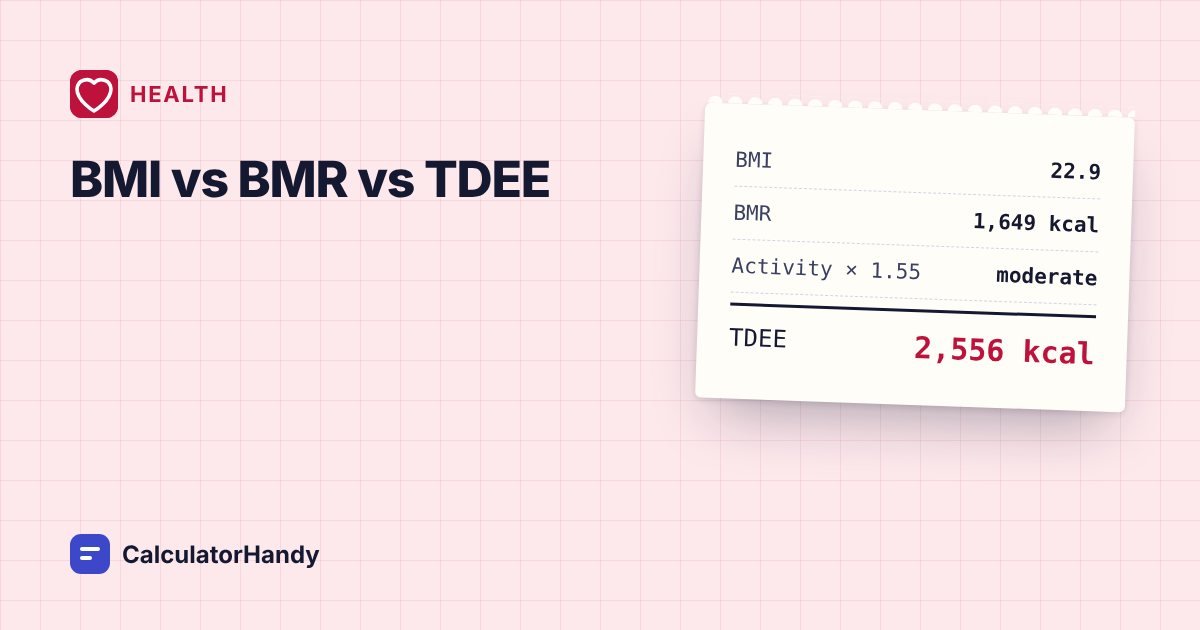
BMI = 70 ÷ (1.75 × 1.75) = 22.9
The World Health Organization classes adult BMI as underweight below 18.5, healthy from 18.5 to 24.9, overweight from 25 to 29.9 and obese at 30 or above. For that 175 cm adult, the healthy band is roughly 56.7 to 76.3 kg.
BMI does not know whether weight is muscle or fat, so muscular people can show as “overweight”. Some health bodies, including India’s, suggest lower cut-offs for Asian adults because health risks start at a lower BMI. Treat it as a screening number, not a verdict.
BMR: how much energy does my body use doing nothing?
Basal metabolic rate is the energy your body burns at complete rest: breathing, circulation, keeping warm. The Mifflin–St Jeor equation is the one most dietitians use today:
- Men: 10 × weight (kg) + 6.25 × height (cm) − 5 × age + 5
- Women: 10 × weight (kg) + 6.25 × height (cm) − 5 × age − 161
For a 30-year-old man, 70 kg and 175 cm: 700 + 1,093.75 − 150 + 5 = about 1,649 kcal a day. A 28-year-old woman who is 60 kg and 162 cm comes out at about 1,312 kcal.
TDEE: how much do I burn on a normal day?
Total daily energy expenditure adds movement to BMR. It is estimated by multiplying BMR by an activity factor:
| Activity level | Multiplier |
|---|---|
| Sedentary (desk job, little exercise) | 1.2 |
| Lightly active (exercise 1–3 days a week) | 1.375 |
| Moderately active (3–5 days a week) | 1.55 |
| Very active (6–7 days a week) | 1.725 |
| Extra active (physical job plus training) | 1.9 |
Our moderately active 30-year-old: 1,649 × 1.55 ≈ 2,556 kcal a day. That is roughly the intake at which his weight would stay the same.
Putting the three together
- BMI tells you whether a change in weight is worth thinking about.
- BMR is the floor. Eating well below it for long periods is generally not recommended without medical supervision.
- TDEE is the number to plan around. A modest deficit below TDEE leads to gradual weight loss; a modest surplus supports muscle gain.
Which one should you track?
If your goal is general health, BMI together with waist size is a sensible check a few times a year. If you are changing your diet, TDEE is the useful planning number, and BMR is simply the floor beneath it. Weighing yourself every day mostly measures water and food in your stomach; a weekly average tells you far more about whether your plan is working.
Why your real numbers will differ
All three are population averages. Two people with the same height, weight and age can differ in BMR by a few hundred calories because of muscle mass, genetics, hormones and sleep. Activity multipliers are rough, and most people overestimate how active they are. The practical approach is to start with the estimate, track your weight for three or four weeks, and adjust.
If you are pregnant, managing a medical condition, under 18 or an athlete in heavy training, speak to a doctor or registered dietitian rather than relying on general formulas.
Frequently asked questions
Is BMR the same as the calories I need?
No. BMR is only what you burn at complete rest. Your daily needs (TDEE) are higher because they include movement, exercise and digesting food.
Why does my fitness watch show a different number?
Watches estimate calories from heart rate and movement, and their formulas differ. Treat both numbers as estimates and adjust based on how your weight changes over a few weeks.
Is BMI accurate for athletes?
Not very. BMI cannot tell muscle from fat, so muscular people often show a high BMI despite low body fat. Waist measurement or a body fat estimate gives a better picture.