Students
How to Convert CGPA to Percentage (CBSE, Universities and Abroad)
Convert CGPA to percentage the right way: the CBSE 9.5 rule, common university formulas, worked examples and what to write on job and visa forms.
Application forms love asking for a percentage, while your marksheet shows a CGPA. The conversion looks like a one-line formula, but the right formula depends on who issued your grades. Using the wrong one can understate or overstate your score by several percentage points.
The CBSE method: multiply by 9.5
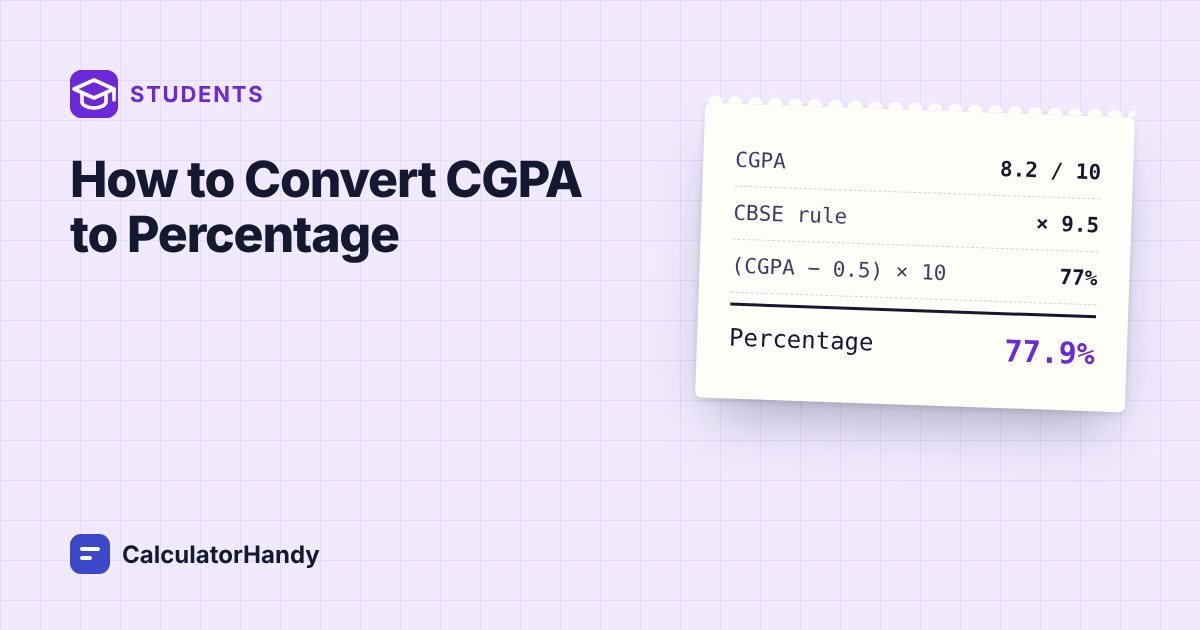
CBSE has long published an indicative conversion for its grading system: percentage = CGPA × 9.5. A CGPA of 8.2 becomes 8.2 × 9.5 = 77.9%.
The 9.5 factor came from CBSE comparing grades with actual marks across students. It is an approximation, and CBSE itself describes it as indicative. If your marksheet shows subject marks, use those for the exact percentage.
University formulas differ
Indian universities and autonomous colleges set their own rules. A few patterns you will meet:
- CGPA × 9.5, borrowed from CBSE, used by many universities.
- CGPA × 10, used by some institutes on a 10-point scale.
- (CGPA − 0.75) × 10 or (CGPA − 0.5) × 10, used by some technical universities.
On the same 8.2 CGPA these give 77.9%, 82%, 74.5% and 77% respectively. That spread is exactly why you should look up your own university’s rule, usually printed on the back of the grade card or in the academic regulations. If it states a formula, that is the one to use on official forms.
From semester grades to CGPA
CGPA is a credit-weighted average of your semester grade points: multiply each course’s grade point by its credits, add them up and divide by total credits. A 4-credit course counts twice as much as a 2-credit one, so a simple average of grade points will be slightly off. The CGPA Calculator does the weighting for you and shows the percentage alongside.
Applying abroad
Universities in the US usually want a GPA on a 4.0 scale, but most do not want you to convert it yourself. They either accept your original transcript or ask for an evaluation from a credential service such as WES. Converting a 10-point CGPA to 4.0 with a homemade formula and writing that on an application can cause confusion. Report the CGPA as it appears on your transcript, with the scale (for example “8.2 / 10”), unless the form asks for something else.
A worked comparison
Say your grade card shows a CGPA of 8.2. Here is what each common rule gives:
| Rule | Formula | Percentage |
|---|---|---|
| CBSE-style | 8.2 × 9.5 | 77.9% |
| Direct | 8.2 × 10 | 82% |
| Offset 0.5 | (8.2 − 0.5) × 10 | 77% |
| Offset 0.75 | (8.2 − 0.75) × 10 | 74.5% |
A 7.5-point spread from the same grades is why the issuing institution’s rule always wins.
What to write on a job form
- If the form allows it, write the CGPA with its scale, for example “CGPA 8.2/10”.
- If it insists on a percentage, use your university’s official conversion and mention it if there is space (“77.9%, CGPA × 9.5”).
- Keep the same figure everywhere: CV, forms and LinkedIn. Mismatches raise questions during background checks.
For marks-based results, the Marks Percentage Calculator gives the exact percentage from obtained and total marks.
Frequently asked questions
Is the CBSE 9.5 formula valid for college CGPA?
Only if your university says so. Many colleges use their own conversion formula, which is printed on the grade card or in the academic rules.
What is the difference between SGPA and CGPA?
SGPA is your grade point average for one semester. CGPA is the credit-weighted average across all semesters completed so far.
Can I round my percentage up?
It is safest to report the percentage to one or two decimals exactly as calculated, or as stated on an official conversion certificate.