Investing
SIP vs Lump Sum: Which Builds More Wealth Over 20 Years?
Compare a ₹10,000 monthly SIP with a lump-sum investment over 20 years, see the maths behind both, the effect of step-up SIPs and when each makes sense.
The SIP-versus-lump-sum debate usually ends with someone quoting a past return. A more useful way in is to look at what each approach does with time, because that is where nearly all the difference comes from. The figures below assume a steady 12% yearly return purely for illustration. Real market returns go up and down, and nothing here is a forecast.
How a SIP grows
A systematic investment plan puts the same amount into a fund every month. Each instalment then compounds for the time it has left. The usual formula, with payments at the start of each month, is:
FV = P × ((1 + i)n − 1) ÷ i × (1 + i)
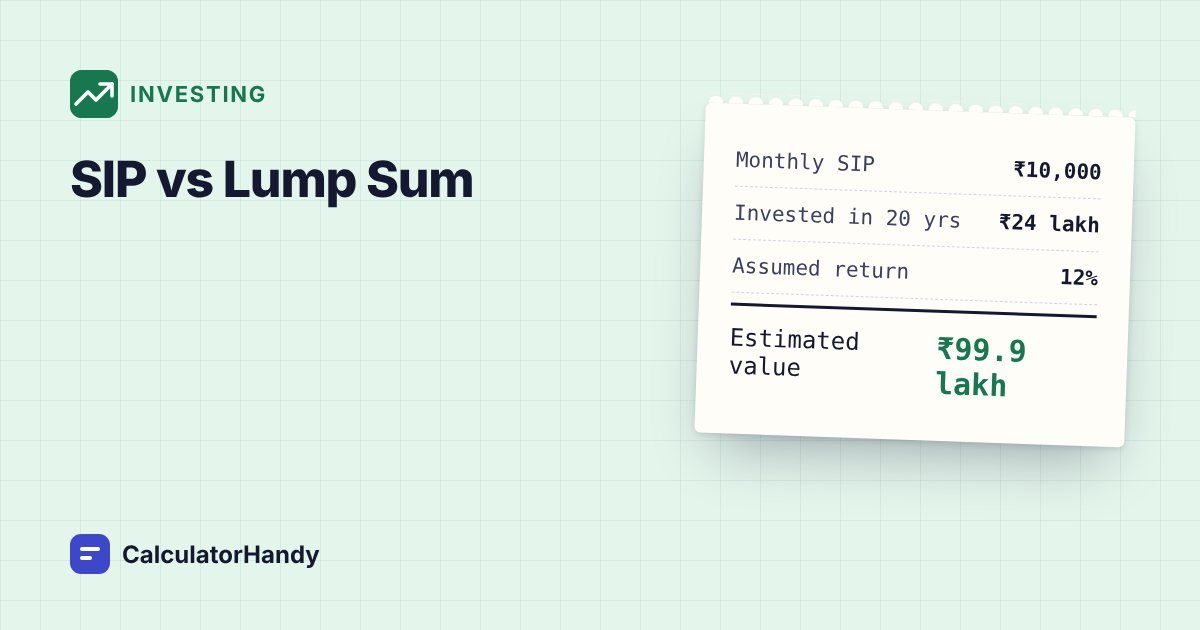
where P is the monthly amount, i the monthly return and n the number of months. With ₹10,000 a month for 20 years at 12%:
- Invested: ₹24,00,000
- Estimated value: ₹99,91,479
- Gain: ₹75,91,479
The lump-sum version
Now suppose you had the same ₹24 lakh on day one and invested it all at 12% for 20 years. It would grow to roughly ₹2.32 crore, more than twice the SIP result.
That is not because lump sums are magic. Money invested on day one compounds for the full 20 years, while the SIP’s last instalment compounds for one month. The fair comparison is not “same total invested” but “what you actually have, and when”. Most salaried people do not have ₹24 lakh sitting idle; they have ₹10,000 left at the end of each month. For them, the SIP is not the slower option, it is the option.
Where SIPs genuinely help
- Rupee cost averaging. A fixed amount buys more units when prices are low and fewer when they are high. It does not guarantee a profit, but it removes the pressure to time the market.
- Habit. An automatic monthly debit is easy to keep going and hard to forget.
- Matches your cash flow. You invest from income as it arrives.
A lump sum tends to come out ahead when markets rise steadily after you invest, and behind if they fall soon after. Since nobody knows which will happen, some investors who receive a bonus or inheritance split the difference: they park it in a low-risk fund and move it into equity in monthly instalments over six to twelve months.
The step-up effect
Salaries rise, so a SIP that never increases slowly shrinks as a share of your income. If you raise the ₹10,000 SIP by 10% every year, you invest about ₹68.7 lakh over 20 years and, at the same assumed 12%, end with roughly ₹1.99 crore: about double the flat SIP. Small yearly increases do more than almost any other change.
What happens if you stop early
Compounding rewards the final years most. In the ₹10,000-a-month example, stopping after 15 years instead of 20 leaves roughly ₹50.5 lakh instead of about ₹1 crore at the same assumed return. The last five years almost double the corpus, because by then a large balance is growing. Pausing a SIP during a market fall, the moment units are cheapest, is the most common way investors lose that effect.
Don’t forget inflation
₹1 crore in 20 years will not buy what ₹1 crore buys today. At 6% inflation, prices roughly triple over 20 years. Use the Inflation Calculator to see what a future amount is worth in today’s money, and set goals in future rupees.
Mutual fund investments are subject to market risk. Past returns do not guarantee future results, and tax on gains depends on fund type and holding period. If the amounts matter, talk to a SEBI-registered investment adviser.
Frequently asked questions
Is a SIP safer than a lump sum?
A SIP does not remove market risk, but it spreads your entry over many months, so a single bad day matters less. Over long periods both carry the risk of the underlying fund.
What return should I assume for a SIP?
There is no fixed return. Use a cautious, a middle and an optimistic rate to see a range, and remember that past returns do not guarantee future ones.
Can I start a SIP with a small amount?
Many mutual funds allow monthly SIPs from a few hundred rupees. Starting small and increasing every year usually beats waiting until you can invest a large amount.