Tax
How to Calculate GST: Add, Remove and Split CGST, SGST and IGST
Step-by-step GST calculation for India: add GST to a price, remove it from an inclusive amount, split CGST/SGST or IGST, with the current 5%, 18% and 40% slabs.
GST maths is simple, but two things trip people up: taking GST out of a price that already includes it, and knowing when the tax is split into CGST and SGST versus charged as IGST. Here is the method with examples you can check against any invoice.
The current GST slabs
Since the GST rate rationalisation that took effect on 22 September 2025, most goods and services fall into two main slabs, 5% and 18%, with a 40% rate for a small list of luxury and “sin” goods. Some items are exempt or taxed at special rates (precious metals, for example). Rates are set by the GST Council and notified by the government, so confirm the rate for your HSN or SAC code before invoicing.
Adding GST to a price
GST = base price × rate ÷ 100 · Total = base price + GST
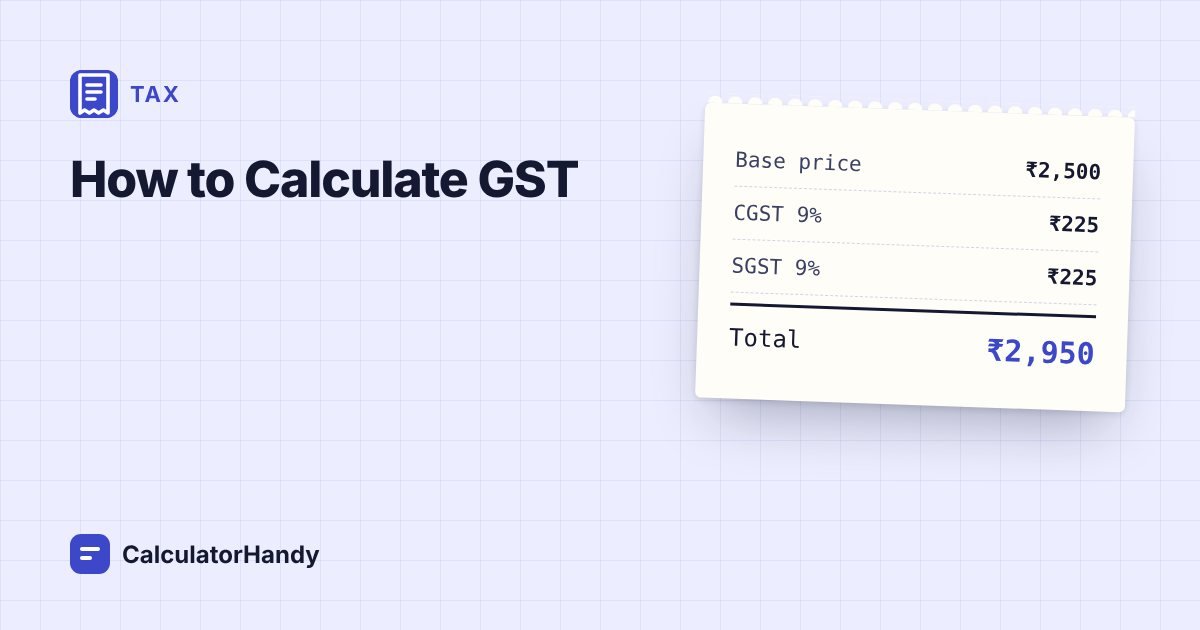
A service billed at ₹2,500 with 18% GST: GST = 2,500 × 18 ÷ 100 = ₹450, so the invoice total is ₹2,950.
Removing GST from an inclusive price
This is where most mistakes happen. If a price of ₹1,180 already includes 18% GST, the GST is not 18% of ₹1,180 (that would be ₹212.40). The tax was added to a smaller base, so you divide:
Base = inclusive price ÷ (1 + rate ÷ 100)
₹1,180 ÷ 1.18 = ₹1,000 base, and GST = ₹180.
CGST + SGST or IGST?
- Intra-state supply (seller and place of supply in the same state): the rate is split equally. 18% becomes 9% CGST + 9% SGST (or UTGST in a union territory). On ₹2,500 that is ₹225 + ₹225.
- Inter-state supply (different states) and imports: the full rate is charged as IGST. On ₹2,500 that is ₹450 IGST.
The total tax is the same either way. The split decides which government receives it and how input tax credit is set off.
A shopkeeper’s example
Suppose you buy stock for ₹10,000 plus 18% GST (₹1,800) and sell it for ₹15,000 plus 18% GST (₹2,700). You collected ₹2,700 from customers and already paid ₹1,800 to your supplier, so the GST you pay to the government is ₹900, subject to the input tax credit rules. Your profit is worked out on the amounts before GST: ₹15,000 − ₹10,000 = ₹5,000.
Mixing GST into profit calculations is a common error. The Profit Margin Calculator works best with pre-tax figures.
Common mistakes on invoices
- Charging 18% on a GST-inclusive price, which taxes the tax.
- Using CGST + SGST for a customer in another state, where IGST applies.
- Rounding each line item differently from the invoice total. Round consistently, usually at the invoice level.
- Leaving out the HSN or SAC code and the GSTIN where they are required.
Quick reference
| Task | Formula |
|---|---|
| Add GST | Base × (1 + r) |
| GST in an inclusive price | Price − Price ÷ (1 + r) |
| CGST and SGST each | Half of the GST amount |
Here r is the rate as a decimal (18% = 0.18). For VAT in other countries the maths is identical; use the VAT Calculator. This guide is general information, not tax advice; for registration, returns and credit rules, consult a GST practitioner or chartered accountant.
Frequently asked questions
How do I calculate GST from the total amount?
Divide the total by (1 + rate). For 18% GST, base = total ÷ 1.18, and GST = total − base.
Is GST charged on discounts?
GST is charged on the transaction value. A discount shown on the invoice at the time of sale usually reduces that value; other discount arrangements have their own rules, so check with a tax professional.
What is the GST rate for my product?
It depends on its HSN code (goods) or SAC code (services). Look it up on the official GST portal or the latest rate notification.